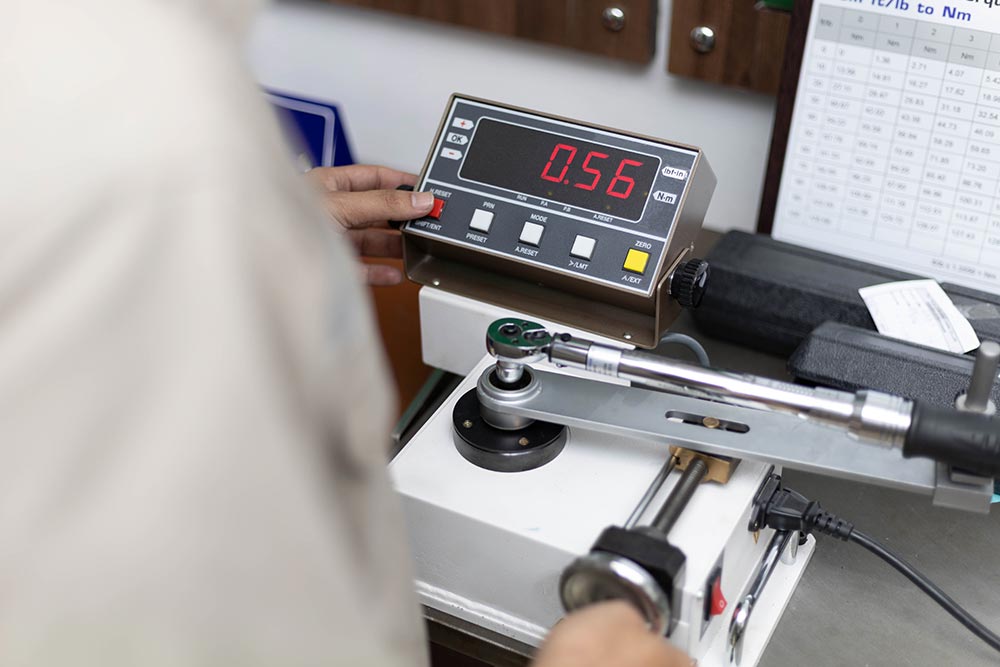
- How often should torque wrench calibrations be done?
Torque wrench calibrations should be performed every 12 months or every 5,000 cycles—whichever comes first. However, high-precision industries or frequent use may require more frequent calibration. At XCalibration, we follow ISO 6789:2017-2 standards to ensure accuracy and compliance.
- Do you offer NATA-traceable torque wrench calibrations?
Yes. All of our torque wrench calibrations are traceable to NATA standards, meeting or exceeding ISO 6789:2017-2 requirements. This ensures your tools are compliant and dependable across industrial, automotive, and aerospace applications.
- Can torque wrench calibrations be completed onsite?
Absolutely. XCalibration offers mobile torque wrench calibration across Brisbane and beyond. Our temperature-controlled service vehicles can come to your location and complete calibrations without disrupting your operations.
- What happens if my torque wrench fails calibration?
If your torque wrench doesn’t meet calibration standards, we’ll provide a full error report and, with your approval, carry out necessary adjustments or repairs. Our team can also advise on replacement parts or provide loan tools to minimise downtime.
- Do you provide a certificate after calibration?
Yes, we issue a calibration certificate with every service, so you can meet quality assurance requirements and maintain compliance documentation.
- What types of torque tools do you calibrate?
We calibrate all major types of torque tools including mechanical torque wrenches, hydraulic torque wrenches, torque multipliers, and digital torque tools. If you’re unsure whether your tool qualifies, contact us for confirmation.
- Is there a recommended torque setting to store my wrench at?
Yes, it’s best to wind your torque wrench back to its lowest marked torque setting (but not zero, unless advised by the manufacturer). This helps relieve spring tension and maintain long-term calibration accuracy.
- Where can you get a torque wrench calibrated?
If you’re searching “where can you get a torque wrench calibrated”, the answer is: with XCalibration. Book into our certified Brisbane lab or have our mobile, temperature-controlled vans attend your site across SEQ and beyond. We provide NATA-traceable calibrations to ISO 6789:2017-2, perform adjustments or minor repairs if needed, and issue a full calibration certificate.
Torque Wrench Calibration Service
Xcal provides torque wrench calibration services to verify accuracy and compliance of torque tools. Calibration ensures torque wrenches operate within specified tolerances and meet quality and audit requirements across industrial and technical applications.
Whether the torque instruments are used for automotive or aircraft maintenance, pipeline work or heavy vehicle maintenance all torque tools are precision instruments and should be treated as such. They should be serviced and calibrated on a regular basis to ensure the operator guaranteed accuracy and that the particular tool is operating at peak performance. Our Nata traceable torque calibration services meet or exceed ISO 6789:2017-2 standards, currently the highest international standard for torque wrench calibration.
You might have heard that it’s important to re-calibrate your torque wrench on a regular basis. Or, you could be wondering whether you need to wind it back to zero after each use. These two questions are crucial for quality and production managers. If your torque wrench isn’t working effectively, then it will have a tremendous impact on the production process.
When exploring issues with calibration, it is important to refer to the ISO6789:2017. This includes key information on quality conformance testing as well as recalibration procedure. Many people do refer to this as the key torque wrench standard.
Back in 1992, this document dictated that tools should be tested at 5000 cycles in both directions. However, there was no guidance provided for when a recalibration should be completed. In 2003, a new edition of the document including quality conformance testing as well as recalibration. It then became important for individuals who were using torques wrenches rather than individuals who were responsible for creating them.